
Virtual Reality With Real Health Outcomes

TEDMED – Firsthand has helped pioneer VR as a digital therapeutic for pain and rehab, mental health, and promoting healthy lifestyles. Howard Rose, co-founder of Firsthand Technology, gives an enlightening overview of virtual reality’s history and enormous potential to improve health and wellness.

More on research and clinical evidence on our Research Page.

Video time: 5:00 minutes   Watch on TEDMED

How VR Hacks the Brain to Make You Better
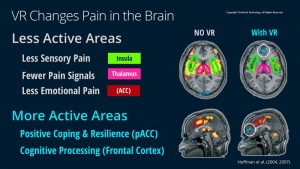
Functional MRI scans show what happens in the brain when we use VR to control pain. These fMRI images reveal significant reduction in pain related brain activity while using VR. Participants using VR also reported feeling less pain during the study, which corroborates the fMRI results.
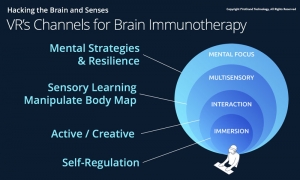
Virtual Reality is a full-body, sensory experience that taps into our ability to perform at our hightest level.  The Power of VR derives from it’s unique aspects of Immersion, Interaction, Multisensory Experience, and Mental Focus. 

White Hat Hacking Our Brains

The brain scans above illustrate how virtual experiences can have profound affects on the brain. Firsthand co-founder, Ari Hollander, explores the implications for VR as an emerging tool to “White Hat” hack our cortex and senses – to help us overcome injury and illness in ways never before possible.

The Future of Fun: MIT Enterprise Forum
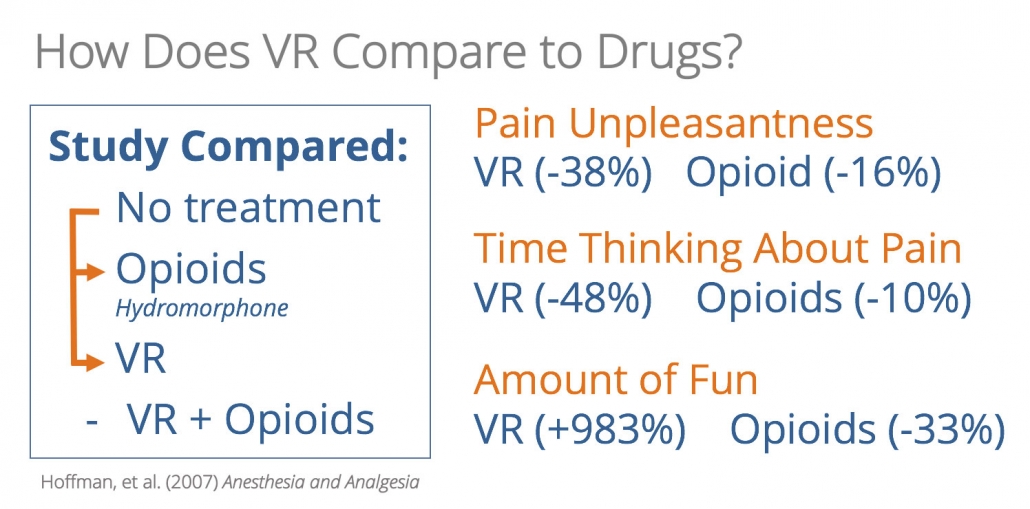
How Does VR Compare with Drugs?

Current treatments for pain mainly involve narcotics, like hydromorphone and morphine, for moderate to severe and chronic pain. Narcotics are notorious for their diminishing effectiveness over repeated use which can lead to dosage escalation and dependence. There is a global epidemic of misuse of pain medication and in many cases the remedy has become worse than the symptom.

Hoffman et al. (2007) compared the VR game, SnowWorld, to opioid pain relievers. Each person in the study (n=9) experienced heat pain in 4 conditions: no treatment control, opioids only, VR only, opioids with VR.

The findings were astounding. VR significantly reduced pain and the time thinking about the pain (catastrophizing). VR was also a lot more fun than the no-treatment control, but participants actually rated opioids as worse than having no treatment. This study was a significant milestone to demonstrate that VR has the potential to out-perform drugs.

Virtual Reality for Chronic Pain

Dr. Diane Gromala’s research team is pioneering VR therapy alternatives to narcotics for moderate to severe and chronic pain. Firsthand is collaborating with Dr. Gromala’s to build virtual worlds that combine the immersion of VR with biofeedback and mindfulness techniques.  These and other studies are beginning to show that virtual reality can increase resilience, thereby providing an effective combination or alternative to narcotic pain medication.

Diane Gromala is an expert in art, design and computer science. Dr. Gromala developed virtual reality (VR) for phobias, anxiety, Parkinson’s and for children who were undergoing chemotherapy. Her VR creations are in use at over 20 hospitals worldwide.   Video time: 16 minutes  Watch on TEDx

The History of VR Pain Research

Over a decade of research and clinical studies have shown that immersive virtual reality can significantly reduce pain, relieve stress, and build resilience. Firsthand Technology has been a part of the pioneering research teams that have established the field of VR pain control and helped build the first VR pain relief application, SnowWorld.

VR pain control research dates back to Ramachandran & Rogers-Ramachandran (1996) who discovered the link between synthetic visual images and physical pain when they used a low tech “virtual reality box” made with mirrors to relieve amputees’ phantom limb pain. In 2000,  a team at the Human Interface Technology Lab (HITL) led by Director Tom Furness and psychologist Hunter Hoffman published their first results showing a computer-generated virtual reality can significantly reduce a patient’s pain.  Numerous subsequent studies using the VR game, SnowWorld  (built by Firsthand), found VR is significantly more effective than other diversions such as movies and  screen-based computer games.

Prominent research teams led  by Sam Sharar, Walter Greenleaf, Albert Rizzo, Brenda and Mark Wiederhold, David Thomas, Jeffery Gold, and others have corroborated the effectiveness of VR for pain control and delved into the underlying physical and cognitive mechanisms of action.

VR Pain Relief In Action (video)

Lieutenant Samuel Brown returned from Afghanistan with extensive injuries and an uphill battle to rebuild his body and his life. The Virtual Reality game, SnowWorld, (made by Firsthand) helped Sam escape the pain of recovery and physical rehabilitation.
Watch at MSNBC Rock Center

Citations to Key Studies of VR Pain Relief

Key references and journal articles on VR pain relief research: VR Pain Relief Bibliography

Tom Furness: Pioneering VR

Firsthand Technology Inc. all rights reserved